







 Dec
Filter
Decimal Filter (Dec)
Find stocks trading at or near whole-dollar and round-number prices in real time with Trade Ideas Streaming Alerts (Scanner) and Top Lists (Screeners). The Decimal (Price Cents) filter looks only at the part of the price after the decimal point (0.00 to 0.99). Set both values to 0 for whole-dollar prices, or min 0.98 and max 0.02 to bracket them.
Stocks making a run, up and down.
Free account, just an email. No card. Live access for a limited time.

Streaming Alerts check the Decimal (Price Cents) filter the moment each alert fires, and Top Lists can sort by it.
How Trade Ideas finds it: set both the minimum and maximum to 0 to see stocks at exactly a whole-dollar price, or set the minimum to 0.98 and the maximum to 0.02 to see stocks from $24.98 to $25.02 (when the minimum is above the maximum, the filter wraps around the whole number). See Trade Ideas plans and pricing to run it live.
How the Decimal (Price Cents) filter works
Think of the Decimal (Price Cents) Filter like a magnifying glass for stock prices. Instead of looking at the entire stock price, it zooms in only on the change – the numbers after the decimal point. So, if a stock is priced at $52.89, this filter cares more about the .89 part.
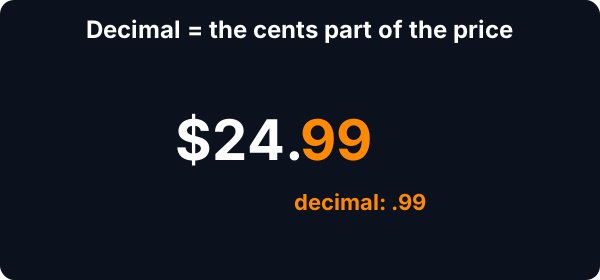
Why Decimals Matter in Trading? Just as we like round figures when negotiating prices in everyday life, the stock market too shows a fondness for whole numbers. Stocks often face resistance or support at these points because many traders set stop-loss orders, take-profit points, or buying orders around these round numbers. For instance, $50, $100, $1,000, etc., are considered more significant than say, $49.57 or $101.23. This filter helps you spot those situations.
Keep in mind
One thing to note: The Decimal (Price Cents) Filter is only for Alert Windows – which notify you of stock movements. It won't be in our Top List (Screener) Windows because those are about ranking stocks, not zeroing in on specific price actions. So, if you're looking to spot activity around exact numbers, this is your tool!

Decimal (Price Cents) filter settings
Activating the Decimal (Price Cents) Filter is straightforward. You'll find its settings under the Window Specific Filters Tab in your Alert Window's Configuration Window.
To filter stocks, you will need to fill in both values with a number that is at least 0.00 and less than 1.00.
- Minimum Value: The smallest decimal value you're interested in.
- Maximum Value: The largest decimal value you're interested in.
Examples:
- Whole Numbers Only: If you set both Minimum and Maximum in the Window Specific Filters Tab to 0, you're saying, "Show me stocks that are exactly at a whole number price." So, stocks at $24.00, $25.00, and so forth.

- Near the Whole Number: If you want stocks that are just around a whole number (a little below or a little above), you'd set Min to 0.98 and Max to 0.02. This means you'll see stocks priced from $24.98 to $25.02.

- Approaching the Whole Number from Below: If you're bullish (expecting the stock to rise), and you want stocks that are just below a whole number, you'd set Min to 0.90 and Max to 0.99. This will show you stocks like $24.90, $24.91...up to $24.99. This indicates stocks that are nearing a whole number from below.

- Approaching the Whole Number from Above: If you're bearish (expecting the stock to fall) and you want to see stocks that have just surpassed a whole number but might fall back, set Min to 0.01 and Max to 0.10. This will show you stocks like $25.01, $25.02...up to $25.10.

Using the Decimal (Price Cents) Filter in Trading
Trader tip
Why Should You Care About Decimals? The stock market is an ocean, vast and unpredictable, but it has its rhythms. One of the intriguing patterns we've observed over the years is the behavior of stocks near whole numbers. Like a magnet pulling iron filings, whole numbers have a psychological pull on traders.
Due to the psychological significance of whole numbers, a lot of trading orders (like stop losses, take profits, or buy/sell orders) tend to cluster around these numbers. This results in an increased level of trading activity near whole numbers, making them potential support or resistance levels. A stock hovering around $29.98 might face resistance at $30.00 because traders set round-numbered price targets.
The Decimal (Price Cents) Filter allows us to spot these subtleties.
Trader tip
The Decimal (Price Cents) Filter, though seemingly simple, opens a realm of strategic trades based on the psychology of whole numbers.
- Breakout/Breakdown Trades : Use the Decimal (Price Cents) Filter to identify stocks hovering just below or above a whole number. Stocks nearing from below might break above, while those nearing from above might break below. If you notice strong buying volume and other bullish indicators, it may be a potential breakout candidate.
- Reversal Trades : Stocks that have recently crossed a whole number and are hovering just above may be susceptible to a reversal if they can't maintain their position.
- Scalping Near Whole Numbers : For those who like quick trades, scalping around whole numbers can be profitable. This involves making several trades to capitalize on small price movements around these psychological barriers.
- Setting Stop Losses and Take Profit Points : When entering a trade based on the Decimal (Price Cents) Filter, set your stop losses and take profits around these whole numbers. They act as natural barriers, making your trades more secure. But be aware of the cons of this practice described in the FAQ section below.
- Combination with Volume : As mentioned earlier, always check the volume when considering trades with the Decimal (Price Cents) Filter. Stocks approaching a whole number with high volume are more likely to break through.
- Combination with Moving Averages : If a stock nearing a whole number is also close to a significant moving average (like the 50-day or 200-day SMA), it adds more weight to the potential price action.
- Combination with RSI (Relative Strength Index) : Combining RSI with the Decimal (Price Cents) Filter can be insightful. A stock approaching a whole number with an RSI above 70 may indicate it's overbought and could face resistance, while an RSI below 30 might suggest it's oversold and could find support.
As with any strategy, practice makes perfect. Begin by paper trading using this filter, understand its nuances, and once comfortable, integrate it into your live trading. Remember, in the vast world of trading, sometimes the devil (or the angel!) is in the details—or in this case, the decimals.
Filters to combine with Decimal (Price Cents)
FAQ
How do I find stocks trading near round numbers?
Add the Decimal (Price Cents) filter (Dec) to a Trade Ideas Streaming Alerts or Top List (Screener) window. Set both the minimum and maximum to 0 to see stocks at exactly a whole-dollar price, or set the minimum to 0.98 and the maximum to 0.02 to see stocks from $24.98 to $25.02 (when the minimum is above the maximum, the filter wraps around the whole number).
What is the Decimal (Price Cents) filter?
The Decimal (Price Cents) filter looks only at the part of the price after the decimal point (0.00 to 0.99). Set both values to 0 for whole-dollar prices, or min 0.98 and max 0.02 to bracket them.
Do round numbers act as support and resistance?
Use the Decimal (Price Cents) filter (Dec) in Trade Ideas Streaming Alerts and Top Lists to find stocks trading at or near whole-dollar and round-number prices. The Decimal (Price Cents) filter looks only at the part of the price after the decimal point (0.00 to 0.99).
Should I set a Stop Loss at a round number?
Setting a stop loss at a round number is a common practice among traders due to the psychological significance of these numbers. However, there are pros and cons to consider:
Pros:
- Simple and Easy: For traders, especially beginners, setting stop losses at round numbers is straightforward and easy to remember.
- Psychological Barriers: Round numbers can serve as psychological support or resistance levels. If a stock has shown historical evidence of bouncing off or stalling at these levels, a stop loss at a round number might make sense.
Cons:
- Predictability: Since many traders place stop orders at or just beyond round numbers, these areas can become targeted. Savvy traders and institutions are aware of this predictability, making these levels susceptible to "stop loss hunting."
- Potential False Breakouts/Breakdowns: Price might momentarily dip below a round number, triggering your stop loss, and then quickly rebound. This can lead to premature exits from trades.
- Not Always the Best Technical Level: While round numbers have psychological importance, they might not always align with the best technical levels derived from other indicators like moving averages, trend lines, or Fibonacci levels.
Recommendations:
- Use a Buffer: Instead of placing a stop loss directly at a round number (e.g., $50.00), consider using a buffer (e.g., $49.85 or $50.15). This can help avoid getting stopped out due to minor price fluctuations around these psychological levels.
- Combine with Other Indicators: Always consider other technical indicators and the stock's historical price action around round numbers before setting a stop loss. This can give you a more comprehensive view of potential support or resistance levels.
- Adjust Based on the Stock's Volatility: If a stock is highly volatile, a wider buffer around the round number might be necessary.
- Stay Informed: If you do place your stop loss at or near a round number, be aware of the potential for increased trading activity at these levels and stay prepared to adjust if necessary.
In conclusion, while round numbers can serve as convenient reference points for stop losses, blindly relying on them without considering other factors can be risky. Always strive for a balanced approach, combining the psychological importance of round numbers with other technical and historical data.
How often do stocks react at these whole number levels?
It's common for stocks to show some form of reaction at whole number levels due to the psychological importance attached to these numbers. Traders and institutions often set orders around these levels, leading to increased buying or selling pressure. However, the frequency and intensity of these reactions can vary based on the stock's volatility, market conditions, and the stock's historical price behavior around these levels.
Is the Decimal (Price Cents) Filter effective for all types of stocks, or are there specific stocks or sectors it works best for?
The Decimal (Price Cents) Filter is a versatile tool that can be applied across various stocks and sectors. However, it may prove more effective for stocks that have shown historical tendencies to react around whole numbers. Stocks with higher liquidity and trading volume often show clearer reactions at these psychological levels. It's always a good practice to backtest any filter or strategy on different stocks and sectors to gauge its effectiveness.
Can I combine the Decimal (Price Cents) Filter with other filters in the Trade Ideas software?
Absolutely! In fact, combining the Decimal (Price Cents) Filter with other filters can provide more precise and tailored trading signals. For instance, you might combine it with a volume filter to find stocks that are not only trading near whole numbers but also experiencing a surge in volume. This combination can hint at a potential breakout or breakdown.
How does the Decimal (Price Cents) Filter differ from other price-based filters?
While there are many filters that focus on price, the Decimal (Price Cents) Filter specifically zooms in on the decimal portion of the stock price, allowing traders to identify stocks trading near whole numbers. This unique focus makes it particularly useful for traders who believe in the psychological significance of round numbers and their influence on stock price movement.
How reliable is the Decimal (Price Cents) Filter in predicting future stock movements?
No single filter, including the Decimal (Price Cents) Filter, can predict future stock movements with absolute certainty. The Decimal (Price Cents) Filter is a tool that helps traders spot potential opportunities based on the theory of psychological price levels. As with any trading tool, its effectiveness will largely depend on the overall market context, the individual stock's behavior, and how it's combined with other trading strategies and tools. Always use the Decimal (Price Cents) Filter in conjunction with other analyses and never rely on it solely for trading decisions.
If a stock consistently respects whole numbers, will that keep happening?
No. Past results, including backtests, are not indicative of future results. While a stock might have historically respected whole numbers, various factors like changing market conditions, company news, or global events can influence its future behavior. It's essential to remain adaptive and continuously monitor and adjust your strategies based on current market data.
Is the Decimal (Price Cents) Filter more effective on shorter or longer timeframes?
The psychological significance of whole numbers applies across various timeframes, but the effectiveness of the Decimal (Price Cents) Filter may vary. On shorter timeframes, you might notice more frequent reactions around whole numbers due to intraday trading behaviors. However, on longer timeframes, these levels might serve as more robust support or resistance levels since they encompass more extended periods of trading activity.
Is there a best practice for adjusting stop losses when using the Decimal (Price Cents) Filter?
When using the Decimal (Price Cents) Filter to identify potential trade entries around whole numbers, consider placing stop losses slightly beyond these numbers to account for potential volatility. As the price moves in your favor, you can employ a trailing stop strategy, moving your stop loss to lock in profits while still giving the trade room to run.
Would the Decimal (Price Cents) Filter still be relevant in high-volatility market conditions?
During high-volatility periods, prices can swing dramatically and might breach whole number levels more frequently. While the psychological importance of these levels remains, the Decimal (Price Cents) Filter's signals might be more prone to false breakouts or breakdowns. In such conditions, it's crucial to use the Decimal (Price Cents) Filter in tandem with other indicators and perhaps employ more conservative settings to filter out excessive noise.
How does news and earnings reports impact the effectiveness of the Decimal (Price Cents) Filter?
Significant news or earnings reports can lead to sharp price movements, sometimes making the Decimal (Price Cents) Filter's signals less reliable in the short term. During such events, prices might breach whole number levels due to external factors rather than their psychological significance. It's advisable to be cautious and factor in the broader market context when trading around major news using the Decimal (Price Cents) Filter.
Are there specific sectors where the Decimal (Price Cents) Filter tends to be more effective?
While the Decimal (Price Cents) Filter can be used across all sectors, its effectiveness might be more pronounced in sectors where retail investors are more active, given that round numbers hold psychological importance primarily for human traders. In sectors led by institutional trading, algorithmic trades might overshadow the effects of psychological price levels.
Would the Decimal (Price Cents) Filter's significance diminish with the rise of algorithmic trading?
Algorithmic trading, which relies on pre-programmed instructions to execute trades, doesn't have the psychological biases of human traders. However, given that many algorithms are designed to exploit human behaviors in the market, whole number levels might still be relevant. The key is to understand that while the Decimal (Price Cents) Filter is rooted in human psychology, it still plays a role in markets run by algorithms.
Does the Decimal (Price Cents) Filter work better during specific times of the trading day?
The opening and closing hours of the trading day often see heightened activity. During these times, stocks might experience increased volatility around whole numbers due to higher trading volumes. Being aware of these timeframes can help traders harness the Decimal (Price Cents) Filter's potential more effectively.
Can the Decimal (Price Cents) Filter be used in conjunction with fundamental analysis?
Absolutely! While the Decimal (Price Cents) Filter is a technical tool, it can be combined with fundamental insights. For instance, if a stock is fundamentally strong and is trading near a whole number, the Decimal (Price Cents) Filter could help pinpoint a more precise entry or exit point.