







 CashDebt
Filter
Cash / Debt Ratio Filter (CashDebt)
Find companies with a strong cash-to-debt ratio in real time with Trade Ideas Streaming Alerts (Scanner) and Top Lists (Screeners). The Cash/Debt Ratio compares a company's cash holdings to its total debt, a quick read on liquidity and leverage.
Watch the market turn, stock by stock.
Free account, just an email. No card. Live access for a limited time.

Seeing a balance-sheet-strong stock start to move as it happens helps active traders. The Cash / Debt Ratio filter value changes once a day, so Streaming Alerts apply it the moment each alert fires: you see only the stocks that pass it, while they are moving.
How Trade Ideas finds it: set the minimum value to 10 to see only stocks with a strong cash/debt ratio of at least 10/1. See Trade Ideas plans and pricing to run it live.
How the Cash / Debt Ratio filter works
The cash debt ratio is a financial metric used to assess a company's liquidity and leverage by comparing its cash holdings to its total debt obligations. Here's a detailed explanation of the "Cash/Debt Ratio" filter:
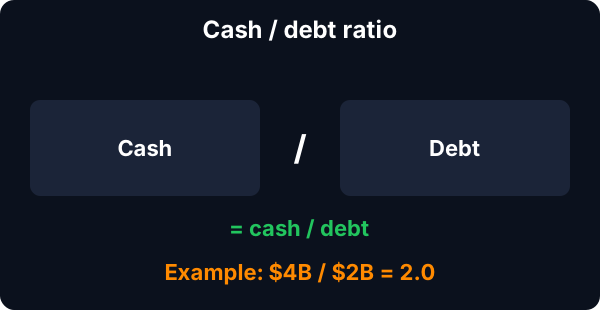
Definition: The cash debt ratio is calculated by dividing a company's cash reserves by its total debt. The formula for the cash debt ratio is: Cash / Debt
This ratio provides insights into the company's ability to meet its debt obligations using its available cash resources.
Interpretation:
Key point
Larger Value: A larger cash debt ratio indicates that the company has a higher level of cash relative to its total debt. This suggests that the company has sufficient liquid assets to cover its debt obligations comfortably. Companies with larger cash debt ratios are generally considered financially stronger and less reliant on external financing to meet their debt obligations.
Smaller Value: Conversely, a smaller cash debt ratio suggests that the company has lower cash reserves relative to its total debt. This indicates higher leverage and may raise concerns about the company's ability to manage its debt payments, especially during periods of financial stress or economic downturns. Companies with smaller cash debt ratios may be perceived as more leveraged and potentially riskier investments.
Trader tip
Traders use the cash debt ratio as a quick measure of a company's liquidity and financial strength. A higher cash debt ratio is generally viewed positively, as it indicates that the company has more cash on hand to cover its debt obligations. However, it's essential to consider the context and industry norms when interpreting the cash debt ratio. Different industries may have varying levels of cash holdings and debt obligations, so it's crucial to compare a company's cash debt ratio to its peers within the same industry.
Cash / Debt Ratio filter settings
Configuring the "Cash/Debt Ratio" filter is simple and can be done within the Window Specific Filters Tab of the Configuration Window in your Alert or Top List (Screener) window.
Here's how to set up the filter in your configuration window:
- Set the minimum value to 10 to see only stocks with a strong cash/debt ratio of at least 10/1.

Using the Cash Debt Ratio Filter
The "Cash/Debt Ratio" filter can be used in various trading strategies, including:
- Focus on High Cash/Debt Ratio Stocks: Screen for stocks with higher cash/debt ratios compared to their industry peers or historical averages. Companies with ample cash reserves relative to their debt obligations may be better positioned to weather economic downturns, pursue growth opportunities, and withstand financial shocks. Consider investing in companies with strong liquidity positions and favorable cash/debt ratios.
- Contrarian Approach: Identify companies with relatively low cash/debt ratios compared to their peers but with strong fundamental characteristics and growth prospects. These companies may be undervalued or overlooked by the market due to concerns about their leverage. If the company's financial health and growth potential outweigh the perceived risks, consider taking a contrarian stance and investing in undervalued stocks with potential for revaluation.
- Sector Rotation Strategies: Analyze cash/debt ratios across different sectors and industries to identify sector rotation opportunities. Shift focus towards sectors with higher cash/debt ratios or sectors where companies are actively reducing their debt levels. Conversely, consider reducing exposure to sectors with lower cash/debt ratios or sectors facing increased financial risk due to excessive leverage.
Filters to combine with Cash / Debt Ratio
Categories
FAQ
Which companies have more cash than debt?
Add the Cash / Debt Ratio filter (CashDebt) to a Trade Ideas Streaming Alerts or Top List (Screener) window. Set the minimum value to 10 to see only stocks with a strong cash/debt ratio of at least 10/1.
What is the Cash / Debt Ratio filter?
The Cash/Debt Ratio compares a company's cash holdings to its total debt, a quick read on liquidity and leverage.
What is a good cash to debt ratio?
Use the Cash / Debt Ratio filter (CashDebt) in Trade Ideas Streaming Alerts and Top Lists to find companies with a strong cash-to-debt ratio. The Cash/Debt Ratio compares a company's cash holdings to its total debt, a quick read on liquidity and leverage.